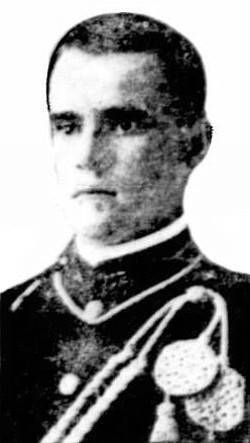
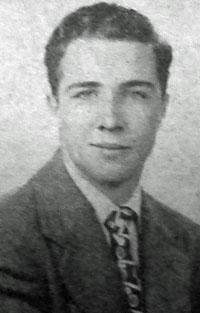
|
Corporal Ralph G. Wagner
United States Army (1941-1943)

Ralph George Wagner was born on
September 5, 1918, the son of Alma E. and Ralph W. Wagner. He had one brother,
William. The Wagner family lived in Wheeling, West Virginia and Ralph was a
graduate of Wheeling High School. The Wagners then moved to Brookline in 1938
and settled at 827 Brookline Boulevard.
Employed as a plumber, Ralph married
Grace Grimes of 1613 Wareman Avenue on September 26, 1941, and the newlyweds
moved in at 2820 Shawhan Avenue. No sooner did they get comfortable than Ralph
was drafted into the U.S. Army on October 27. He reported for induction
and basic training at Fort Meade in Maryland.
Assigned to Company D, 168th Infantry
Regiment, 34th Infantry Division (known as the Red Bull Division), Ralph left
home on April 24, 1942 for the New York Port of Embarkation. On April 30 he set
sail for Northern Ireland, arriving at Belfast on May 10 to join the rest of the
34th Division, which had been arriving piecemeal since January.
 
During these training days in North Ireland,
on June 25, 1942, the King and Queen of England witnessed a demonstration by the
168th Infantry Regiment. The outstanding event of that day was when Queen
Elizabeth rode with General Hartle in a bouncing jeep over the rough terrain. Their
Majesties surprised the men with their stories of courage and fortitude during the
German Blitz. The King and Queen moved about freely among the men.
The 168th Regiment left Ireland on October
26 to sail for North Africa and take part in Operation Torch, the invasion the
African continent. The 168th Regiment saw its first combat in French Algeria on
November 8. As a member of the Eastern Task Force, which included two brigades of
the British 78th Infantry Division, and two British Commando units, the Regiment
landed at Algiers and seized the port and outlying airfields.
Elements of the 34th Division took part in
numerous subsequent engagements in Tunisia during the Allied build-up. In the early
months of the invasion, the 168th Regiment was always at the tip of the spear. On
January 31, the Regiment participated in the Battle of Sened Station, a small group
of non-descript buildings near a whistle stop along a Tunisian Railroad. Here they
would meet the advancing units of German General Rommel's Afrika Corps head
on.
 
Soldiers of the 34th Division advancing along
a road in Tunisia (left) and at the Kasserine Pass.
The night of January 31 was an evening of
pure terror, as the trocps were bombed and strafed by Stukas and fighter bombers
of the all powerful German Luftwaffe, who at this point in time had complete
mastery of the skies.
Undetered, on the morning of February 1, the
168th Regiment attacked the German lines. The advance was slow and at one point
halted by the withering enemy fire. In the face of impending disaster, through the
dash and daring of the regimental leaders, the soldiers rallied and turned the tide
of battle against the Germans. In the end the enemy retreated and the 168th had
dealt a significant blow to the numerically superior foe.
There was no rest for the tired, battered
troops. Orders came on the morning of February 2 to attack and seize the high ground
overlooking the plains leading to Sfax. By 1400, the objective had been reached and,
despite heavy bombing and strafing, and the action of enemy tanks and artillery, the
position was held until the evening of February 4. When the reinforced Germans
threatened to encircle the Regiment, the order to withdraw was given.
These were the opening stages of the German
attack that culminated with the Battle for the Kasserine Pass. The 168th Regiment also participated in defensive
actions at Sidi Bou Zid, Faid Pass and Sbeitla. At this time, Rommel and his Panzer
Army were an inexorable force and cut through the beleageured Americans, forcing a
general retreat along the entire front. During these bitter battles the 168th
Regiment was effectively destroyed.
 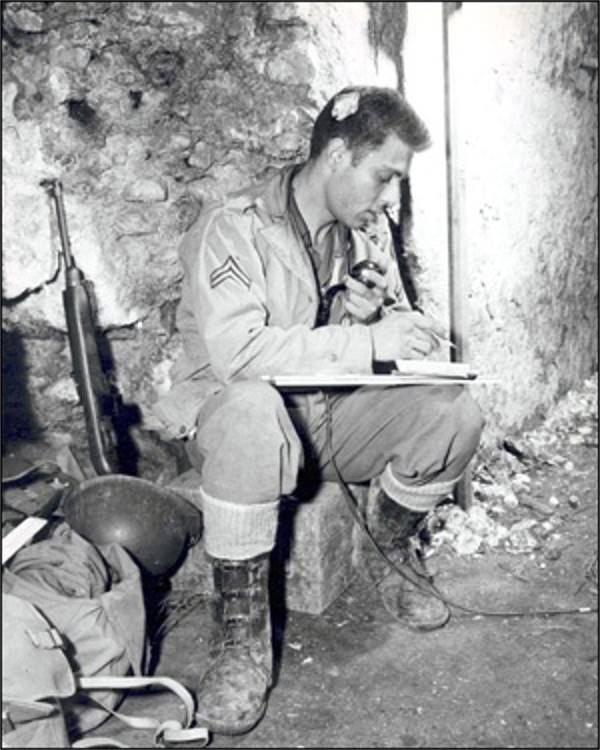
Soldiers of the 34th Division in North Africa
cleaning weapons (left) and writing home.
After a month in the rear regrouping and
being replenished with replacements, the reconstituted 168th Regiment was back up
to combat strength. Additionally, there was a change of leadership at the top, with
General George S. Patton taking overall of the American forces. The overall situation
improved in terms of equipment, training and morale. By the end of March, the
Regiment was back at the front ready to attack.
The 168th participated in the bitter fighting
to take the high ground around the Fondouk Pass. The two week battle culminated in
a German withdrawal, but the success came at a steep price. Once again the Regiment
was decimated. Total casualties amounted to 357 soldiers killed, wounded or
missing.
Then, in April 1943 the 168th Regiment was
engaged in the assaults to capture Hill 609, the key high ground in the German
defense of Tunisia. After several days of fierce fighting, the hill was captured on
May 1. Several enemy counterattacks were repelled and, by May 9 the Tunisian
campaign came to an end with the German surrender in North Africa.
The 34th Division skipped the Allied invasion
of Sicily and instead trained intensively for the invasion of the Italian mainland.
During this time it was brought back up to strength with replacement soldiers.
Despite the carnage incurred by the 168th Regiment during the African campaign,
Richard Wagner had made it through unscathed, and was promoted to
Corporal.

Corporal Wagner and the 34th Division landed
on Italian soil as part of the U.S. Fifth Army on September 25, 1943, at Salerno.
They engaged the enemy at the Calore River on September 28 and relentlessly drove
north to take the town of Benvenuto. The Red Bulls crossed the winding Volturno River
three times in October and November.
 
Soldiers of the 34th Division in during the
battle for the southern part of the Italian Peninsula.
Each move across the Volturno was a hazardous
and costly process. The first crossing occurred on October 12. Under cover of a smoke
screen and holding their guns high over their heads, the initial troops moved quietly
into the torrential waters, reaching the opposite bank and struggling up its steep,
slippery slopes.
Immediately enemy mine fields were
encountered, resulting in several casualties. Others crossed some 800 yards farther
downstream in assault boats, some reaching the opposite shore safely and others were
swept downstream with the current, necessitating the abandonment of boats and forcing
the men to ford the stream at shoulder depth. Several men drowned, and radio and other
equipment were rendered useless.
In addition to the river crossings was the
tremendous task of forcing a way through the narrow defiles, which passed through
high, rocky, precipitous heights, at the base of which were small fields, vineyards
and olive groves. To the right of the Division loomed the gigantic range of the
Matese mountains, eternally capped with white snow. Pack mules were often employed
to ferry supplies along the narrow mountain trails.
To add to the difficulties confronting the
advancing troops, rainy weather continued almost without interruption. On such days
as were clear, a heavy, dense fog would descend in the early evening hovering over
the ground until late morning, blanketing out all vision for the troops. So
inclement was the weather that men of the Division came to believe that nature was
conspiring against them and allying herself with the retreating enemy.
 
The German's organized a skillful defense in
Italy that took a grim toll in the attacking Americans.
Another even more dangerous obstacle in the
path of the advancing troops was the rearguard of the retreating Germans, who proved
themselves to be masters in the art of the orderly withdrawal. Time and again the
enemy left behind well-entrenched small forces that effectively held up the Allied
movement and tool a grim toll in terms of life and limb.
By November 15, the 34th Division had reached
the German Winter Defensive line. Realizing that for the time being, further advance
against the impregnable position of the Germans would prove too costly, and, knowing
that his troops were exhausted from the relentless drive, the advance was halted and
limited activity to patrols and defense missions.
Attacks resumed on November 29, with the
168th Regiment ordered to assault Monte Patano. In the face of strong resistance, the
regiment advanced relentlessly up the hill. The Germans retreated to the reverse slope
under the ferocity and rapidity of the attack. Having secured the objective, the
168th Regiment dug in and awaited the inevitable counterattacks.

Soldiers of the "Red Bull" Division fighting
the Germans along the Winter Line in December 1943.
American and German artillery pounded the hill.
There were many casualties on both sides. For five hours hand-to-hand fighting
continued unabated as the Germans advanced in seven assault waves. Each was stopped
and the enemy finally retreated. The Great German Winter Line was slowly
crumbling.
On the 1st of December it snowed and turned
much colder. That afternoon another German counterattack was broken up. In the
evening a severe artillery and mortar barrage pounded the regimental positions.
Many supply points were struck and badly damaged. At 2200 hours, another intense
artillery and mortar barrage was followed by heavy automatic weapons fire at very
close range. A thick fog then settled over the front making it impossible to
distinguish Germans from Americans.
Pitched hand grenade battles at ranges from
fifteen to twenty yards were taking place all along the line. Some penetrations were
made in Company A's sector, but a fierce bayonet assault drove the enemy from the
position. After several hours of severe fighting, during which the enemy attacked
wave upon wave, the Germans withdrew.
During this battle on Monte Patano, on December
1, 1943, one of the fiercest so far in the history of the 168th Regiment in World
War II, Cpl. Ralph G. Wagner was killed in action.
 
A temporary monument placed on Monte Patano to
honor the 16th Infantry Regiment and the 34th Infantry Division.
After the death of Corporal Ralph G. Wagner,
the 34th Division fought for eight more days atop Monte Patano before being relieved.
The Red Bulls went on to fight in the Battle for Monte Casino and participated in
the battle for the Anzio Beachhead. The Division finished the war in Northern
Italy.
The 34th Division participated in six major
Army campaigns in North Africa and Italy. It is credited with amassing 517 days
of front-line combat, more than any other Division in the U.S. Army. One or more units
of the 168th Regiment was engaged in actual combat for 611 days. The Red Bulls
suffered 2,866 killed in action, 11,545 wounded in action, 622 missing in action,
and 1,368 men taken prisoner by the enemy, for a total of 16,401 battle
casualties.

Back home in Brookline, word of her husband's
fate reached Grace Wagner in early January 1944. Initially Ralph was listed as Missing
in Action, as reported by the Pittsburgh Press on January 16. His status was changed
to Killed in Action a month later. Ralph's name appeared in the daily casualty listing
on February 12.
While the community of Brookline mourned the
loss of another local soldier, the Blue Service Star that hung in the window of the
Wagner home at 2820 Shawhan Avenue was changed to a Gold Star by Ralph's grieving
widow.
Corporal Ralph George Wagner's body was buried
temporarily in Italy, then returned to the United States in the summer of 1949. He
is permanently interred at Arlington National Cemetery in Virginia.

* Written by Clint Burton:
May 23, 2018 *
The Brookline
War Memorial

Listed below are
many of the sons of Brookline who gave their
lives to preserve freedom and contain aggression during
World War I, World War II, Korea and Vietnam.
“It is foolish and wrong to mourn the men who died.
Rather, we should thank God that such men lived.”
General George S. Patton


World War I
(1917-1919)
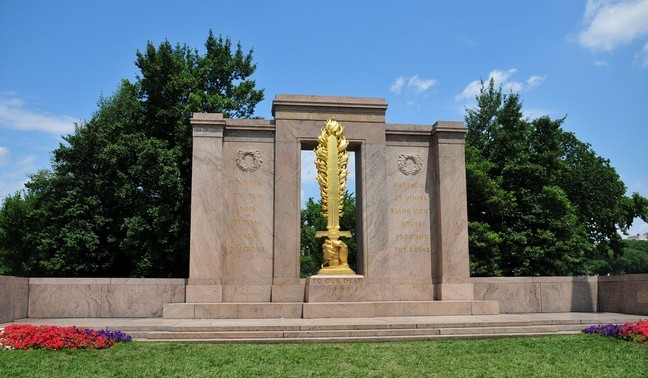
The World War I Memorial -
Washington D.C.
<> <>
<> <> <> <> <> <> <> <>
<> <> <> <> <> <> <> <>
<> <> <> <> <> <> <> <>
<> <> <> <> <> <>
World War II
(1941-1945)
|
Alm, William H.
Pioneer Avenue
Army
Details |
Arensberg, Roy T.
Fernhill Avenue
Army
Details |
|
Bracey, Bruce H.
Plainview Avenue
Army
Details |
Brickley, Edward G.
Woodward Avenue
Army
Details |
|
Capogreca, James J.
Merrick Avenue
Navy
Details |
Copeland, Clarence R.
Creedmoor Avenue
Navy
Details |
|
Cullison, Thomas J.
Birtley Avenue
Army
Details |
Dempsey, Howard F.
Berkshire Avenue
Army
Details |
|
Dempsey, Walter F.
Milan Avenue
Navy
Details |
Diegelman, Edward R. Jr
Norwich Avenue
Army
Details |
|
Dornetto, Frank P.
Jacob Street
Navy
Details |
Doyle, John F Jr.
Eben Street
Navy
Details |
|
Fagan, Gerald B.
Woodbourne Avenue
Army
Details |
Falk, Harold E.
Pioneer Avenue
Army
Details |
|
Fehring, Robert M.
Fernhill Avenue
Army
Details |
Gmuca, Joseph J.
Brookline Boulevard
Army
Details |
|
Heil, Robert F.
Bayridge Avenue
Army
Details |
Hynes, Richard E.
Waddington Avenue
Army
Details |
|
Kestler, Paul C.
Creedmoor Avenue
Navy
Details |
Ketters, Robert C.
Berkshire Avenue
Army
Details |
|
Mahoney, Michael J.
Oakridge Street
Army
Details |
Majestic, Arthur B.
Starkamp Avenue
Army
Details |
|
Mayberry, Alexander G.
Breining Street
Army
Details |
Mazza, John
Alwyn Street
Army
Details |
|
McCann, Robert F.
Edgebrook Avenue
Navy
Details |
McFarland, Hugh R.
McNeilly Road
Army
Details |
|
Meisner, Walter F.
Berwin Avenue
Merchant Marine
Details |
Miller, William J.
Norwich Avenue
Army
Details |
|
Napier, Edward J.
Brookline Boulevard
Army
Details |
Nicholson, John D.
Woodbourne Avenue
Army
Details |
|
O'Day, John R.
Creedmoor Avenue
Navy
Details |
Orient, Andrew D.
Fordham Avenue
Army
Details |
|
Pisiecki, Raymond A.
Wolford Avenue
Army
Details |
Reeves, Alfred M.
Brookline Boulevard
Army
Details |
|
Reitmeyer, John P.
Bellaire Avenue
Navy
Details |
Rhing, Vern M.
Norwich Avenue
Army
Details |
|
Ruane, Roy J.
Berkshire Avenue
USMC
Details |
Shannon, Harry C.
Midland Street
Army
Details |
|
Shannon, Jack E.
Midland Street
USMC
Details |
Simpson, James D.
Woodbourne Avenue
Army
Details |
|
Spack, Harry
Linial Avenue
Army
Details |
Tobin, Paul M.
Woodbourne Avenue
Army
Details |
|
Vierling, Howard F.
Fordham Avenue
Army
Details |
Wagner, Ralph G.
Shawhan Avenue
Army
Details |
|
Wentz, Walter L. Jr
Woodbourne Avenue
Army
Details |
Zeiler, Harold V.
West Liberty Avenue
Army
Details |

The World War II Memorial -
Washington D.C.
<> <>
<> <> <> <> <> <> <> <>
<> <> <> <> <> <> <> <>
<> <> <> <> <> <> <> <>
<> <> <> <> <> <>
Korean War
(1950-1953)

Korean War Memorial -
Washington D.C.
<> <>
<> <> <> <> <> <> <> <>
<> <> <> <> <> <> <> <>
<> <> <> <> <> <> <> <>
<> <> <> <> <> <>
Vietnam War
(1965-1973)
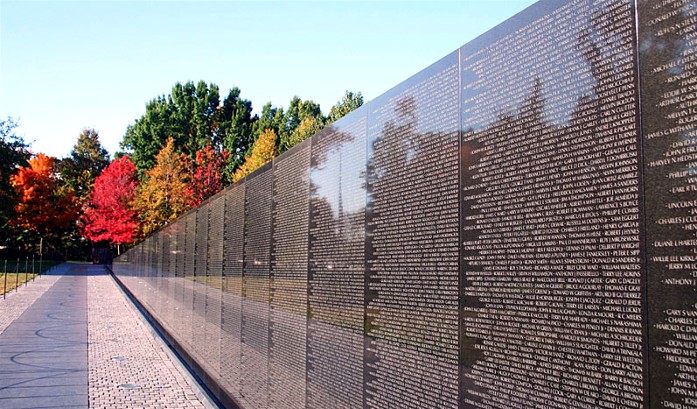
Vietnam War Memorial -
Washington D.C.
The Brookline
Monument - The Cannon

<Brookline
War Memorial> <> <Brookline
History> |